

The roads Uttarakhand shares with six crore visitors
Story and photograph: Nitin Deshdeep · 10 min read
The three-hour drive
The drive from Haldwani to Almora is ninety kilometres on the two-lane state highway. It climbs from the terai plains through Ranibagh, past Bhimtal, through the bottleneck at Kainchi Dham, and toward the heart of Kumaon. In the off-season, the drive takes about three hours.
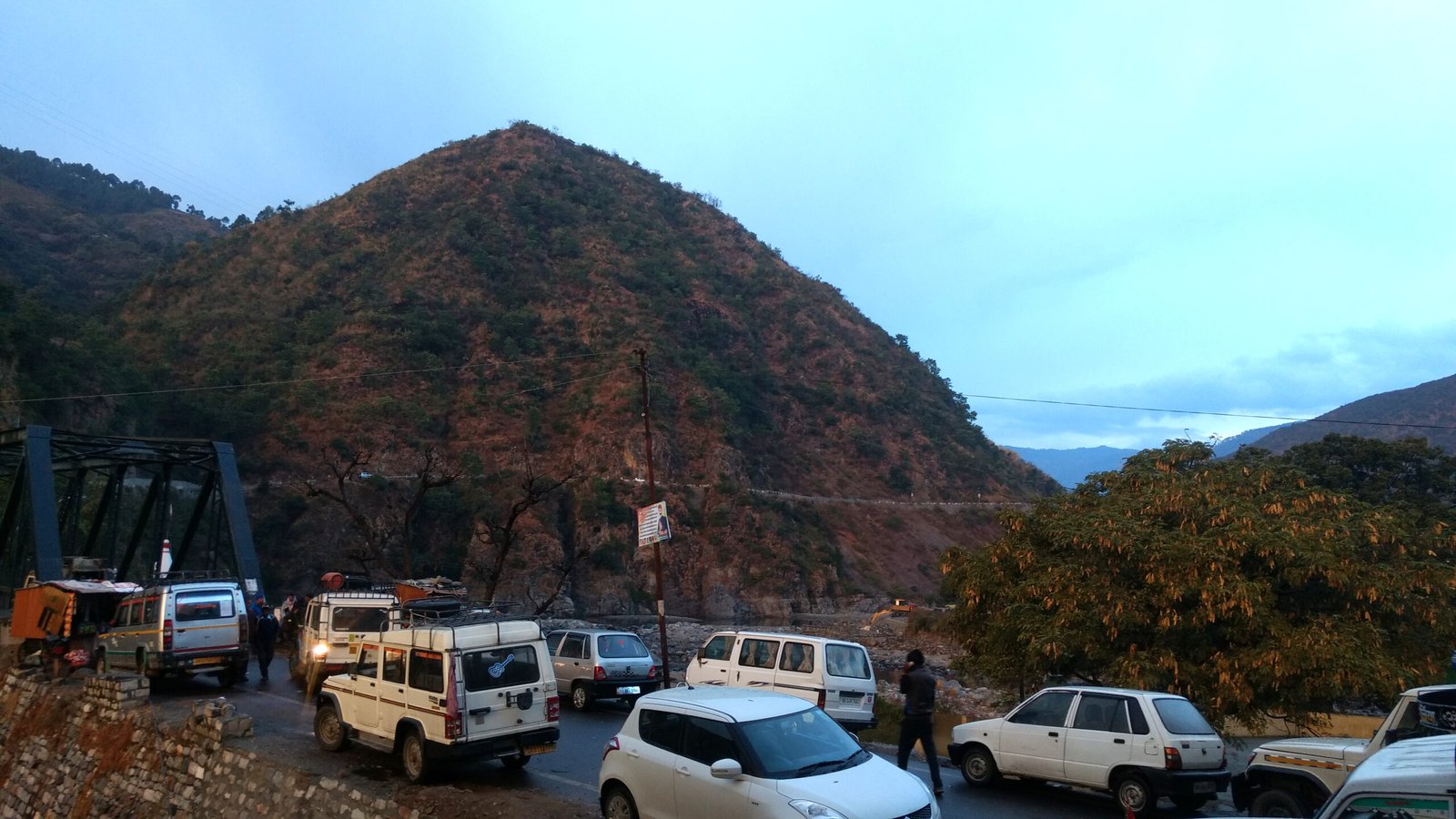
In the third week of June 2026, I drove from Haldwani to Almora, and it took six hours. The return trip, later that same week, took six again. What led to this was the number of vehicles on the road — tourist cars, SUVs, tempo travellers heading deeper into the hills, to Bageshwar, Pithoragarh, Munsiyari. Most of them pass through Almora because it is the most direct route into upper Kumaon, and the one almost every driver uses.
This is the tourist season. In Uttarakhand, it runs from the time Delhi’s schools close for summer until they reopen — roughly the same months when the Char Dham pilgrimage pushes hundreds of thousands of vehicles up the Garhwal valleys. For the people who live on these roads and depend on them to get to work, move goods, or reach a hospital, the season means the road they need most works the least.
What the season costs in Almora
The shared taxi from Almora to Delhi usually costs about three hundred rupees per person. During peak season, the cost jumps to seven hundred to eight hundred. The drivers charge this because the same journey now takes most of their waking hours — twelve to thirteen hours on routes that used to take half of that. The competition during the season is fierce and the driving is exhausting.
The off-season is worse. When the tourists leave, the work leaves with them. There is no steady income for a taxi driver on these routes outside the summer months. The drivers depend on the tourist season for their income, but it is also the time when their work is the hardest. Every driver I have spoken to during the season says the same thing — the hours are long, the roads are unpredictable, and when the season ends, there is nothing.
My house in Almora sits next to the state highway. The road is two cars wide. Residents who live off the main road have no choice but to park their vehicles on it, because there is nowhere else. With cars parked along one side — sometimes both — the moving road narrows to less than two lanes. In the off-season, this is manageable. During the season, hundreds of tourist vehicles heading to Bageshwar or Pithoragarh pass through this same road every day, and the reduced road carries them all. A drive to my mama’s house sits in the same traffic as the through-traffic.
When vehicles line up in kilometres of jam and stand for hours, the road collects what the traffic leaves behind. Plastic bottles, food wrappers, packaging. A study on tourist behaviour in Mussoorie, published in Circular Economy and Sustainability, found that eighty per cent of shopkeepers reported tourists dropping waste near roadsides rather than using dustbins. Of two thousand tourists observed outdoors, fewer than four hundred used the bins provided. The waste is not only from tourists — locals caught in the same jams add to it — but the volume rises and falls with the traffic.
Six crore visitors, the same roads
Uttarakhand recorded 6.03 crore tourists in 2025, according to the state tourism department — the highest figure since the state was formed. In 2019, the last full year before the pandemic, the state hosted 3.92 crore visitors, according to a study in the Journal of Mountain Research. In six years, the number has grown by more than 50 per cent. The government’s stated target is seven crore by 2030, according to IBEF.
Uttarakhand draws nearly double the annual tourist volume of Himachal Pradesh, which crossed three crore in 2025 — itself a seventy-two per cent jump from 2024, according to its state tourism department. The gap between the two states is driven largely by religious travel. The Char Dham circuit alone pulls millions of pilgrims each season, and sites beyond the main four — Jageshwar, Kainchi Dham, and others — are now drawing lakhs of visitors of their own, adding pressure to roads that were already full.
These numbers arrive on roads that were not built for them. Nainital’s roads have capacity for roughly three thousand vehicles. On summer weekends, fifty thousand attempt to enter, according to Himalayan Geographic.
The pressure runs along every corridor. In Garhwal, twenty to twenty-five thousand vehicles cross through Rishikesh daily during the Char Dham season, according to police figures reported by NewKerala. On a June 2025 weekend, traffic in Haridwar between Alaknanda Tirahe and VIP Ghat moved at barely a kilometre per hour, as reported by India TV. The Haridwar-Rishikesh highway was blocked ten kilometres before Rishikesh, forcing vehicles into a fifty-kilometre detour through Dehradun — with no signage at the diversion points, according to a first-hand account on Team-BHP.
Devprayag, where two rivers meet and the highway narrows, is one of the most regular bottlenecks in the state. Drivers who know the route often bypass it entirely, taking the longer road through Kotdwar and Pauri to avoid the jam. The detour adds distance but can save hours on a bad day — a measure of how broken the main road gets during the season.
In Dehradun, the police now operate a full weekend traffic management plan for Mussoorie, Rishikesh, and Chakrata — with tiered diversions, multiple re-routing plans, and a rule that halts vehicles at King Craig parking once ninety per cent of Mussoorie’s parking capacity fills. As of June 2026, this is routine, according to Business Standard.
Broken stretches
Every monsoon, landslides take sections of hill highway — sometimes the entire road, leaving the government to find or build an alternate route through the hillside. More often, a stretch of tarmac collapses and what remains is gravel and loose earth. These stretches sit on the same routes the tourist traffic uses, and each one slows everything behind it. The road-widening projects meant to increase capacity compound the problem: they cut into slopes that the monsoon then brings down.
What Himachal has already seen
In the last weekend of May 2026, eighty-five thousand vehicles entered Shimla. Over forty-five days between May 1 and June 15, fifteen lakh vehicles entered the city, according to the Tribune. Shimla police deployed two hundred and ten extra personnel and divided the city into five traffic sectors to manage the flow. This is not a crisis response — it is the seasonal norm.
The traffic is the most visible daily problem, but in Himachal it is no longer the only one. In May 2018, Shimla nearly ran out of water. The city’s water system could supply 40 million litres per day; peak-season demand reached 56 million, according to the World Bank. Residents received water once every eight days. Over a hundred people staged a midnight protest at the waterworks office on Mall Road. Residents and hotels sent messages on social media asking tourists to stay away — during the peak of summer season. The Himachal Pradesh High Court stepped in, ordering a halt to construction and car-washing and banning water tanker deliveries to VIP areas while ordinary residents had dry taps. Hotels lost bookings; the local economy, built on the tourists now being turned away, took the hit. The crisis forced institutional reform — a new dedicated water utility was created with World Bank support — but it began with the same arithmetic the traffic problem runs on: more people than the system was built for.
Five years later, the 2023 monsoon killed around five hundred people across Himachal Pradesh. The state recorded 5,748 landslides. Over fifty thousand people were displaced. Economic losses reached ₹8,665 crore, according to the NDMA. The NDMA’s own report cited unplanned construction on unstable slopes and loss of green cover as key factors. In July 2025, the Supreme Court warned that Himachal Pradesh could vanish from the map if the environmental damage continues, naming road-widening projects and hotel construction among the causes.
Traffic, water, slope stability — each is a different system, but they break for the same reason: more load than the infrastructure and the terrain can hold. Uttarakhand is on the same curve. It draws twice the tourist volume Himachal does, its government is building expressways to bring visitors faster, and its carrying-capacity studies remain completed but unimplemented. The question is not whether the same pressures will arrive, but how far behind they are.
Ambulances in traffic
On June 9, 2025, Jagmohan Singh, a forty-year-old shopkeeper from Dhaniyakot near Nainital, began vomiting blood. His family called 108. The first ambulance broke down. A second was sent. It got stuck in tourist traffic near Kainchi Dham — the same bottleneck on the Nainital-Haldwani road that turns three-hour drives into six-hour ones every season. A journey that normally takes two hours took more than five. He was declared dead on arrival at the hospital in Haldwani, according to PTI.
Four days earlier, Kamal Kishore Tandon, a sixty-two-year-old tourist from Delhi visiting Mussoorie, fell ill. His family took over an hour to cover less than four kilometres to the nearest medical facility in Landour, according to PTI. He did not survive.
Two deaths in four days, on two different roads, from the same cause. These are the documented extremes — the point where the doubled travel times and the daily gridlock produce a cost that cannot be recovered.
What the government builds
The state government sees the record numbers as a success.
Tourism Minister Satpal Maharaj credited the six-crore figure to what he described as proactive policies and infrastructure upgrades, according to Indian Masterminds. Chief Minister Pushkar Singh Dhami called tourism a major pillar of the state’s economy and said the government is promoting tourism throughout the year, as reported by ETV Bharat.
The infrastructure the government is building supports this direction. The Delhi-Dehradun Expressway, inaugurated on April 14, 2026, cuts the drive from Delhi to Dehradun from five hours to two and a half. It is designed for twenty to thirty thousand vehicles a day. A further extension — a twenty-six-kilometre elevated corridor from Dehradun to Mussoorie, budgeted at ₹6,100 crore — is planned. The road from the plains to the hills is getting faster and wider. The roads inside the hills are neither.
Anoop Nautiyal, founder of the Dehradun-based Social Development for Communities Foundation, has argued that this approach is counterproductive — that faster highways into the hills only accelerate the load on roads that cannot absorb it. In his June 29, 2026 post on X, he went further: more roads, tunnels, bridges, and highways are not the answer. Hill towns have a limited capacity, and the only way to address this is through regulation and carrying capacity enforcement. There is, he wrote, no other way.
The regulatory record does not suggest urgency. The National Green Tribunal directed states to assess the carrying capacity of hill cities in March 2021. Uttarakhand completed assessments for six cities — including Nainital, Mussoorie, Almora, and Haldwani — through the School of Planning and Architecture, Delhi, submitting reports in late 2024, according to ThePrint. What has been acted on is unclear. Mussoorie introduced mandatory tourist registration from August 2025, following an NGT directive. Nainital is considering a similar system but has not adopted one — the town is also a district headquarters and the seat of the High Court, which makes a blanket rule harder.
In Himachal Pradesh, the NGT ordered carrying capacity studies for Manali and McLeodganj through an expert committee in 2017-18. A Tribune India investigation found that the recommendations gathered dust. The studies were done. The enforcement was not.
For the Char Dham pilgrimage routes, the NGT directed Uttarakhand in April 2026 to file a carrying capacity report. As of that hearing, the report was still pending, according to Down to Earth.
The people on both sides
The tourists are not the problem. Six crore visitors bring an economy that the hills depend on. The taxi drivers who spend thirteen hours on the road during the season have no work at all when the season ends. The hotels, the shops, the dhabas along every route from Haldwani to Munsiyari run on what the summer months bring in.
The people coming from Delhi, Gurgaon, Noida, and Bangalore are not coming to do harm. They are coming because they need what the hills have — a few days of quiet, clean air, and a break from the cities they live in. They deserve the hills as much as anyone.
What the evidence from both states shows is a gap, and the gap is not between tourists and locals. It is between the government that counts six crore visitors and announces the record, and the same government that has not built the hill roads, the parking, the traffic management, or the emergency systems to hold what those numbers actually produce. The expressway from Delhi to Dehradun takes two and a half hours. The road from Haldwani to Almora takes whatever the traffic allows. One end of the route is engineered for the load. The other carries it without the engineering.
A taxi driver on the Haldwani-Almora route cannot fix this. Neither can the family from Delhi whose car is part of the traffic. The capacity to act sits with the government that brings the visitors and celebrates the count. The roads — and the people on both sides of them — are waiting for the rest of the work.