

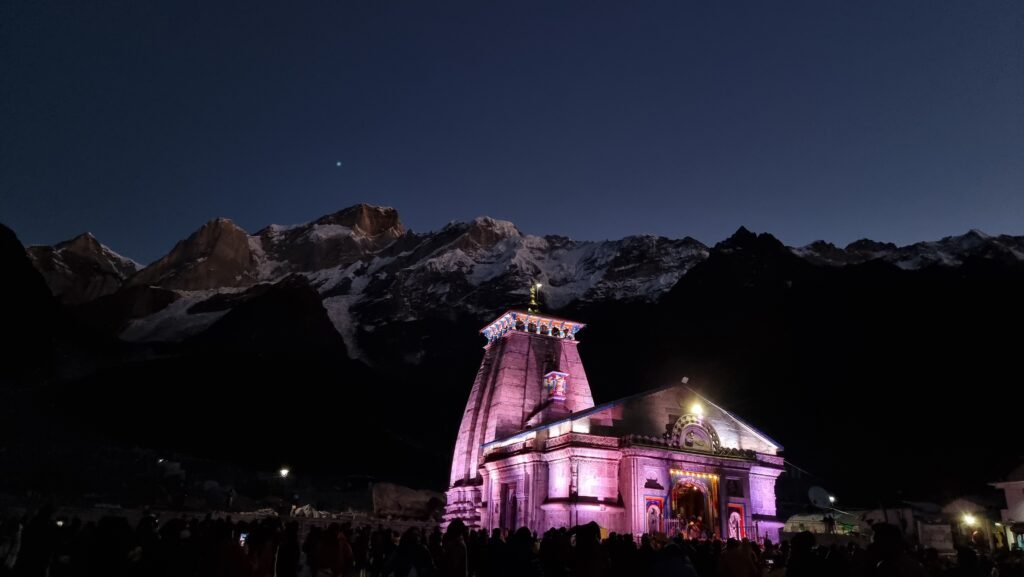
Kedarnath at 32,000 pilgrims a day
Story and photograph: Hisalu · 5 min read
On 22 April 2026, 38,000 pilgrims reached the Kedarnath temple — the highest single-day opening count in the pilgrimage’s history. By mid-May, the daily average had settled around 32,000, nearly double the previous year. A research study completed five months earlier had recommended that the temple receive no more than 13,111 visitors a day. The first month, however, saw a total of 6,65,140 pilgrims.
The temple sits at 3,583 metres, above the Mandakini river valley that was devastated in the 2013 floods. The temple itself survived; the town around it was destroyed and rebuilt for a permanent population of roughly 5,000.
The limit and its removal
The 2025 study that recommended a limit of 13,111 visitors based its recommendation on elevation, slope, and vegetation cover — the physical constraints of the site. The study was carried out by researchers from Veer Chandra Singh Garhwali Uttarakhand University and GB Pant National Institute of Himalayan Environment. The Uttarakhand government has at various points set its own limits. In 2023, the Rudraprayag district magistrate announced a daily cap of 13,000. In 2024, the cap was set at 12,000. Neither held.
On 10 April 2026 — twelve days before the temple doors opened — Chief Minister Pushkar Singh Dhami removed the cap entirely. “For now, we have decided to remove the cap on the number of pilgrims so that there are no restrictions,” he told reporters.
The record
The government’s framing of the 2026 season has been consistent: a record to celebrate. Ten days in, with 4,08,401 pilgrims across the four shrines, Dhami called it “a good record.” The Kedarnath redevelopment under Prime Minister Narendra Modi was credited with the surge. The state launched a “Green and Plastic-Free Char Dham Yatra” campaign, with both Dhami and Modi appealing to pilgrims to avoid single-use plastic. By mid-June, Dhami reported over 35 lakh total Char Dham pilgrims and pointed to the All-Weather Road and the Rishikesh-Karnaprayag rail project as evidence of improved infrastructure.
The deaths
Fifty-five pilgrims died in the first thirty days of the 2026 yatra, according to the State Emergency Operation Centre report dated 18 May. Thirty of those deaths were at Kedarnath — more than all other shrines combined. The data was published by the SDC Foundation, a Dehradun-based organisation that tracks Char Dham pilgrimage numbers using official government sources.
On opening day itself, 69-year-old Dilip Bhai Manu Mali from Gujarat suffered cardiac arrest on the trek. His son Hemant told reporters he waited over an hour for medical help, then carried his father on his shoulders to the nearest health centre, where he was declared dead. The family said the body was left on the helipad for two hours before a helicopter was arranged. Uttarakhand aviation officials said the delay was due to mandatory DGCA safety inspections.
The waste
In the first week of the 2026 season, the Kedarnath Nagar Panchayat collected approximately 1,000 kilograms of plastic waste — most of it water bottles, according to executive officer Neeraj Kukreti. By 5 May, with more than 3.35 lakh pilgrims through, 7 tonnes had been processed at Sonprayag. By 19 May, district magistrate Vishal Mishra reported 25 tonnes collected along the route and over 50 tonnes through the Deposit Refund System.
The government has put real infrastructure behind the effort: a 3,000-square-foot Material Recovery Facility at the temple that segregates waste into 15 categories; the Deposit Refund System, which charges a Rs 10 deposit on every plastic product and refunds it on return; a Carry Me Back programme distributing waste bags for pilgrims to carry their dry rubbish down to Gaurikund. Free toilets stand along the trek route at roughly one-kilometre intervals.
Some of this works: the toilets are clean; and and pilgrims use the bags.
The question is scale. Data obtained by environmentalist Amit Gupta through RTI filings show that in the 2025 season — May to October — Kedarnath generated 21.4 metric tonnes of solid waste, the highest in five years and a 22 per cent increase over 2024. Of that, roughly 40 per cent was processed. The remaining 12.7 metric tonnes was dumped in landfills or open areas near the base camp. Between 2022 and 2024, just 32 per cent of the 72.53 metric tonnes generated at the temple was processed. The rest was dumped.
The waste at the temple is one layer. The towns along the route — Phata, Sonprayag, Sitapur — generate their own, and collection infrastructure thins out quickly beyond the temple area.
Then there is the sewage. Kedarnath currently has no operational sewage treatment plant. An inspection by the Uttarakhand Pollution Control Board in 2025 found untreated sewage being discharged directly into the Mandakini and Saraswati rivers. A 600 KLD STP is under construction, designed for a permanent population of 5,000 and a floating population of 20,000. Even at its intended capacity, the STP will not cover days when footfall crosses 25,000 — and in the 2026 season, that is most days.
The route to the temple
Not every pilgrim arriving at Kedarnath needs a bed. Many — especially those arriving by helicopter — attempt same-day darshan and return, often queuing for hours at the temple before heading back down the same day. But the strain on the route applies to everyone who reaches the top: the trail, the water, the waste, the queues.
The temple area can house 4,000 to 5,000 pilgrims at a time. For those who plan to stay the night when 32,000 are arriving daily, the arithmetic is plain. Government guesthouses operated by GMVN limit stays to one night during peak season and fill months in advance. What remains is shared tents — large shelters where pilgrims sleep in rows, close enough that turning over is a negotiation — or the open ground beside the temple.
The 16-kilometre trek from Gaurikund shares its path with over 8,000 registered mules and horses, against a carrying capacity of 2,250 recommended by a joint committee of the Uttarakhand Pollution Control Board, MoEFCC, and GB Pant Institute in a report to the National Green Tribunal. In 2022, 175 equines died during the season — three on the first day. Veterinarians along the route treat 20 to 30 injured mules a day during peak season, for saddle sores, leg wounds, and exhaustion. The animals carry pilgrims and goods in both directions on a track that was not built for this traffic.
The gap
The carrying capacity study completed in November 2025 recommended 13,111 visitors a day. The government had set caps near that number before — 13,000 in 2023, 12,000 in 2024 — and neither held. In April 2026, it stopped setting them altogether. The season that followed averaged 32,000 pilgrims a day, thirty deaths at Kedarnath in the first month, and a waste system that processes roughly 40 per cent of what the mountain receives. The remainder goes to the landfill near the base camp — the same site that filled up in 2023, was replaced, and filled up again in 2024.