

Harela
Pahad Culture · Festivals
Harela is a festival of Kumaon, held on the first day of the month of Saavan (Shravan) — the start of the monsoon, and of the sowing season. About ten days before the festival, families sow seeds at home. The young plants are cut on the festival morning, offered to the gods, and then placed on the heads of the family by their elders as a blessing [4]. The plants are also called harela.
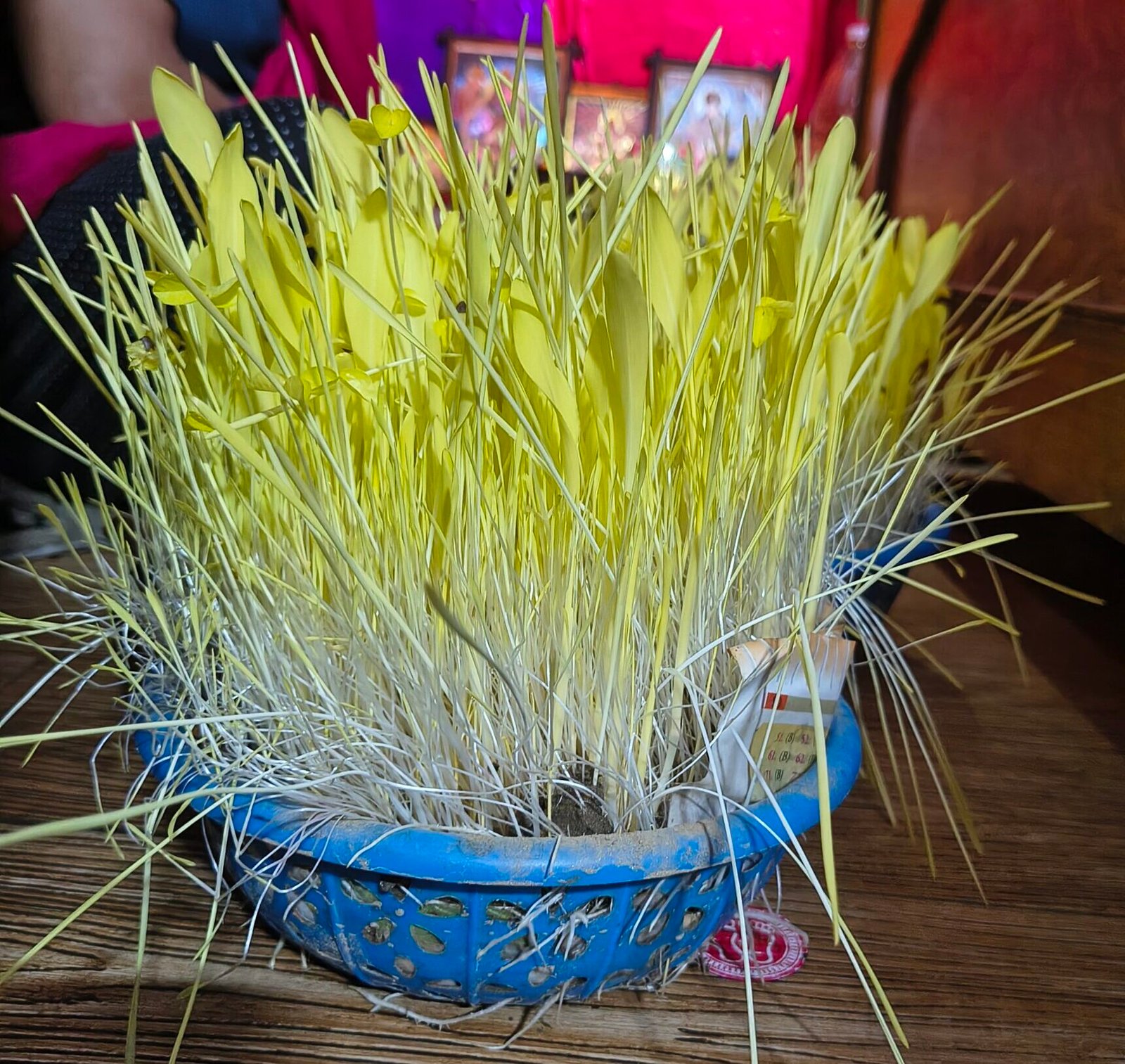
The preparation begins ten or eleven days before the festival, depending on the household [4]. Seeds are sown in a small pot or tray of soil kept in the house, and water is sprinkled over them each day. Some households sow five kinds of grain, some seven, some eleven [2]. For example, here’s a set of seven seeds sown in a household in Almora: paddy, wheat, barley, sesame, mustard, maize, and black gram, called maas in the hills [4]. By the festival day the pot is thick with young shoots (shaped like grass) and their color sits between yellow and light green [4]. The belief is that the taller and fuller the harela grows, the better the coming harvest will be [2].
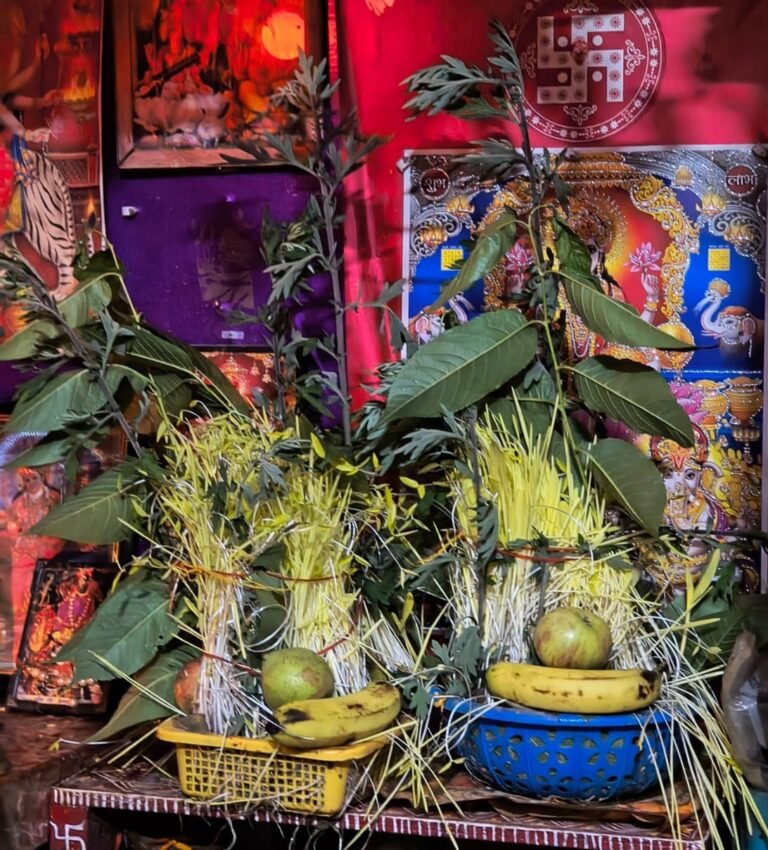
The Saavan Harela falls on July 16 or 17. On the festival morning, the harela is cut. The first portion goes to the Gods in the temple at home[4]. Then the elders of the house place the shoots on the heads of the younger members, and speak a blessing over them [1][4]. One version of the verse, as it is said in Kumaoni homes:
Jee raye, jagi raye, yo din yo maas bhetnai raye. Dharti jas chakav, aakash jas ucch hai jaye. Surya jas taran, syav jas buddhi hai jou. Doob jas failiye, sil pisi bhaat khaye, jaanth teki jhaad jaye. [4]
May you live, may you stay aware, may you meet this day and this month again. May you be broad as the earth and high as the sky. Bright as the sun, wise as the fox. May you spread like doob grass, eat rice ground on the sil, and walk with a stick into old age.
The day’s meal is festive — pooris, badis (fried rounds of ground maas), and fried sweets, called pua in some homes [4].
By the traditional calendar, Harela comes three times a year: once in Chaitra, near Ram Navami; once in Saavan; and once in Ashwin, around October [2][4]. The Saavan Harela is the one that survives in most homes. Researchers at the G.B. Pant National Institute of Himalayan Environment in Almora note that the other two are observed less and less, as cropping choices change and fewer families carry the knowledge forward [2].
The festival extends beyond the household in places. In Bhimtal, a Harela mela runs from July 16 to 21, with local crafts, music, and performances [2].
The state goverment has run tree-planting drives on Harela for several years [3]. In 2025, the government reported more than 8.13 lakh saplings planted in a single day, against a target of 5 lakh, under the slogan “Harela ka tyohar manao, dharti maa ka rin chukao” — celebrate Harela, repay the debt of mother earth [3]. Chief Minister Pushkar Singh Dhami opened the drive by planting a rudraksh sapling in Dehradun [3]. The government says more than 80 percent of the saplings planted on Harela over the past three years have survived [3].
The household ritual has not been displaced by the public one. Harela is still sown and cut in the cities, carried mostly by the generation now past its fifties [4]. Their children have grown up receiving the harela, not sowing it. Whether they will keep the ten days of preparation, and not only the festival day, is the open question of the tradition [4].
Sources
- [1] Harela 2024: Know the date, origin, significance, celebrations and more — The Indian Express
- [2] Ritual as Resilience – Celebration of Harela festival — LEISA India
- [3] Uttarakhand sets record with over 8.13 lakh saplings planted on Harela festival — ThePrint (PTI)
- [4] Based on local knowledge provided to Hisalu.