

Golu Devta
Pahad Culture · Faith
Golu Devta is the god of justice of the Kumaon hills. In villages across Kumaon, he is the ishta devta — the household deity a family turns to first. He is worshiped as an incarnation of Gaur Bhairava, a form of Shiva. His main temples stand at Chitai near Almora, Ghorakhal near Bhowali, and Champawat. Devotees bring him their disputes in writing: petitions on plain paper and court stamp paper, tied at these temples beside brass bells or ghanti [1]. The locals affectionately call him Goljyu [1].
Petitions and bells
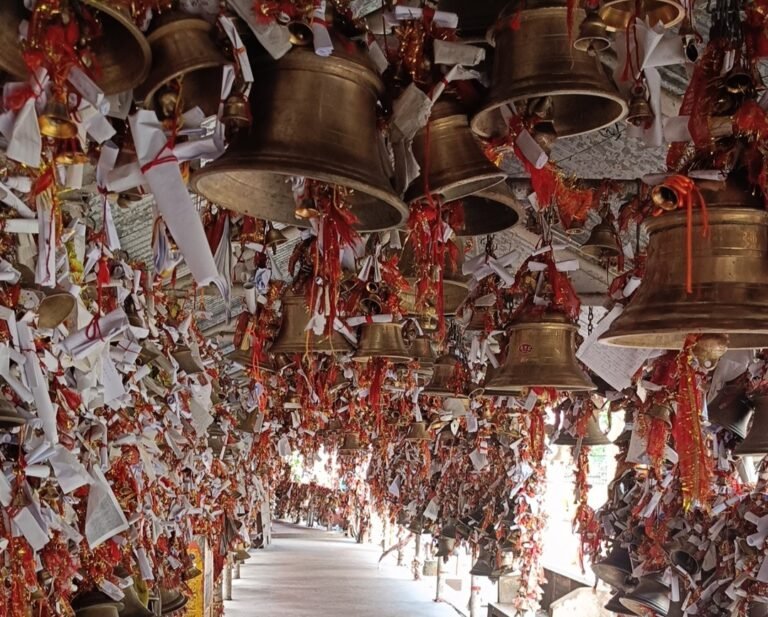
Golu Devta is worshiped differently from the other deities of Kumaon. Devotees write down their grievances on a sheet of notebook paper, on court stamp paper, sometimes with the documents of a pending case attached — and tie it at his temple. The petition hangs there with the others until the matter is resolved. Then the devotee returns with a ghanti.
The bell is not offered in advance. In their prayers, devotees promise Golu Devta a bell of a certain weight if he intercedes, and the bell is offered only after justice is delivered [2]. This is why the temples look the way they do: walls, railings, and walkways disappear under lakhs of bells and layers of grievance paper, gathered over generations. Most of these bells mark petitions that were answered [2].
For instance, a survey was conducted at Chitai, and it found land documents, a photocopy of a house deed, marriage invitation cards, a note asking for help with a medical problem, and student pleas about examinations [2]. C.M. Agarwal, who studied the practice for his book Golu Devta: The God of Justice of Kumaun Himalayas, cataloged around 23 categories of petitions, from job appointments to land disputes [2]. Many petitions concern matters already before the courts — stamp papers and case documents are a familiar sight on the temple walls.
The practice is not reserved for grievances. Across Kumaon, families visit Golu Devta’s temples for any important life event: after a wedding, after buying a new vehicle, when a trouble in the family calls for a pooja [3]. Many households keep his idol in their home shrines.
The legend
The story of how Golu Devta became the god of justice is a legend. The most widely told version begins in Champawat [1]. King Jhal Rai — Halrai in some versions — had seven queens. The seventh queen, Kalinka, gave birth to a son. The other queens, afraid of losing their standing, replaced the newborn with a stone and set the child adrift on the Gori river in a wooden vessel. A fisherman pulled him out and raised him [1]. Years later the boy rode to the king’s court on a wooden horse and led it to the water to drink. When the king asked how a wooden horse could drink, the boy asked how a queen could give birth to a stone. The deception unraveled, and the king recognized his son [1]. The prince who exposed an injustice done in his own cradle came, after his death, to be worshiped as the deity who undoes injustice.
The versions do not agree on the dynasty. Oral traditions place the story under the Katyuri kings in some and under the Chands of Champawat in others [1]. In the wider family of Kumaoni deities, Golu Devta is seen in the form of Shiva, his brother Kalva Devta in the form of Bhairava, and Garh Devi in the form of Shakti [4].
The temples
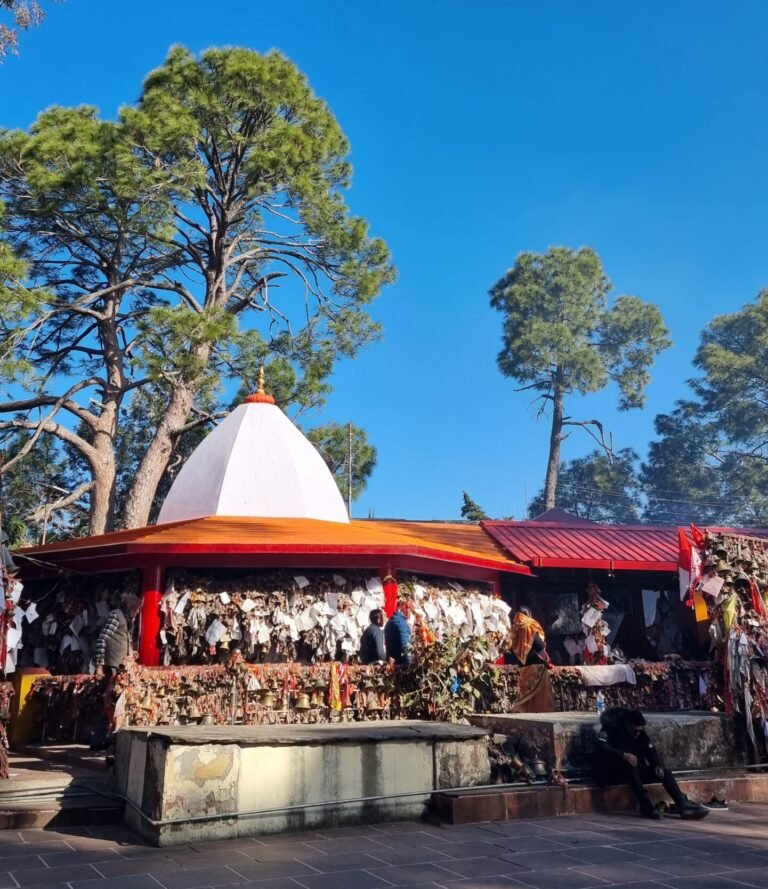
The busiest Golu Devta temple is in Chitai, about 10 kilometers from Almora on the road toward Jageshwar [5]. It stands in chir pine forest: a small white-domed sanctum inside a courtyard so densely layered with bells, red cloth, and paper that the railings underneath are hard to find. Local tradition holds that the temple was built after Golu Devta appeared in the dream of a Pant Brahmin and asked for a shrine at Chitai [2]. By then the Chand kings had moved their capital from Champawat to Almora, and the Champawat temple is regarded as among the oldest of his shrines [1].
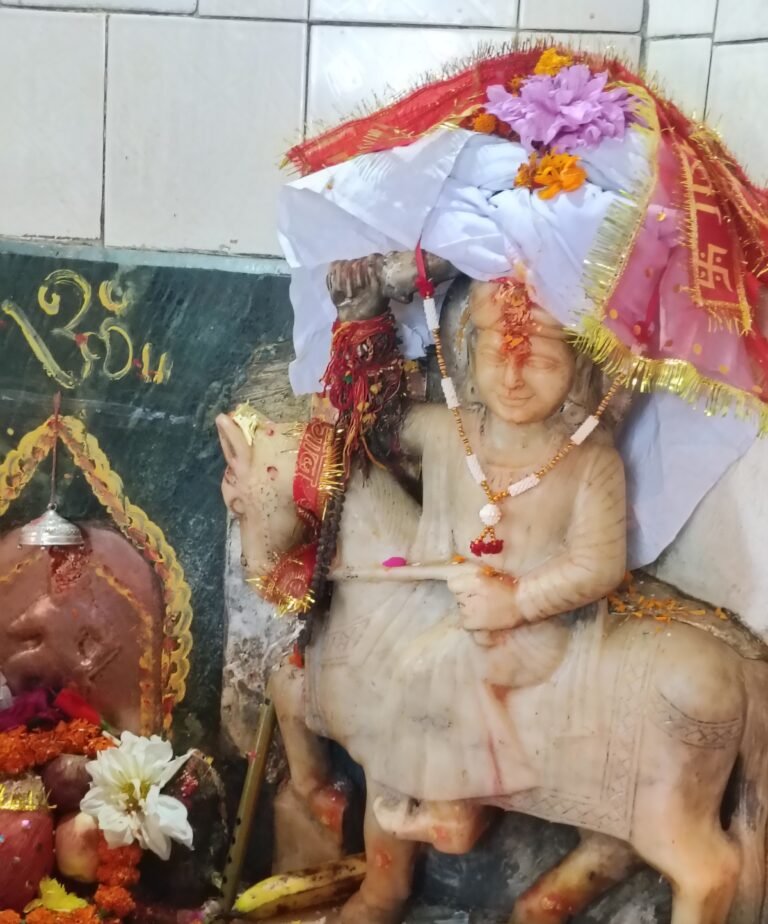
The worship at these sites has changed shape over time. The most recent addition is a marble idol of a king on a white horse; the older objects of worship were the dhuni — the sacred fire pit — surrounded by iron spears and tridents [2]. In the local classification of deities, Golu Devta is a rajanaya devta, a royal ancestor, and the classification shows in what he is offered: poori, halwa, and flowers, the food set before a benevolent king [2]. The offerings follow his color as well — white cloth, a white pagri, a white shawl, for the god who rides a white horse [4].
Ghorakhal, near Bhowali in Nainital district, is the other heavily visited temple, known above all for the mass of its bells. And near Dinapani, on the road toward Binsar, stands Gairar, also called Dana Golu, which the Almora district administration describes as the original and most ancient temple of Golu Devta [4]. Here too, the stories differ. The district’s account ties Gairar to Kalyan Singh Bisht — Kalbisht, a folk hero beheaded through a conspiracy, whose body is said to have fallen at Gairar [4]. Another story, told at Chitai, says the nearby Dana Golu temple belongs to Golu Devta’s murdered uncle [2]. In Kumaon’s folk religion, heroes, ancestors, and deities merge in the retelling, and the temples carry the versions side by side.
Jagar and the household
In the Kumaon hills, Golu Devta is invoked in rural households in a practice called jagar. The jagar is the night ritual of the Uttarakhand hills in which a singer, the jagariya, recites the ballad of a deity to the beat of the hurka and the dhol, or a steel plate — the thali [6]. In many villages, the thali alone carries the beat [3]. The singing wakes the god and calls him into the body of a human medium, the dangariya, who then speaks, hears the problems of the household, and gives remedies [6]. A jagar may last one night or extend into a baisi — a longer sitting of eleven or twenty-two nights [1]. The jagar is held in homes and village courtyards, and it is where the legend has lived for generations.
The present
Golu Devta’s temples are busier than they have ever been. Chitai and Ghorakhal now sit on the tourist circuits of Kumaon, recommended to visitors alongside Jageshwar and Binsar, and the flow of petitions and bells has grown with the footfall [3].
One part of the tradition has ended. Animal sacrifice was once offered at Golu Devta’s temples, including Chitai, on the fulfillment of wishes [3]. When two public interest petitions seeking a statewide ban reached the Uttarakhand High Court, representatives of temples across the state told the court that many had already given up sacrifice on their own. The court’s December 2011 judgment recorded this, held that animals may not be killed to appease deities, and directed that any slaughter in urban areas happen only in licensed slaughterhouses [7]. At Chitai, the practice ended around 2012 [3]. In 2018, the High Court banned animal sacrifice inside temples outright [8].
The jagar remains a village ritual, held in homes, and the villages themselves are thinning as families move to the towns and the plains [3]. The temples show the opposite curve. More people stand in the courtyard at Chitai than at any time in memory, and the walls keep taking new paper [3].
Sources
- [1] Golu Devata — Wikipedia
- [2] Goludev of Chitai — Sahapedia
- [3] Based on local knowledge provided to Hisalu.
- [4] Gairad Golu Dev Temple — District Almora, Government of Uttarakhand
- [5] Almora district — Wikipedia
- [6] Jagar (ritual) — Wikipedia
- [7] Judgment in Writ Petition (PIL) Nos. 77 of 2010 and 73 of 2010 — High Court of Uttarakhand at Nainital, December 19, 2011
- [8] Uttarakhand HC bans slaughter in the open during Bakr-Eid, animal sacrifice in Hindu temples — Business Standard (PTI)