

Chholiya
Pahad Culture · Music and Dance
Chholiya is the sword dance of Kumaon. The dancers dress as the hill soldiers of an earlier time and fight staged duels with real swords and brass shields, while moving to drums, horns, and a mashakbeen (bagpipe) [1]. Chholiya is usually part of a wedding procession, where the dancers walk at the front, ahead of the groom’s party. It also appears at fairs, festivals, and public functions — in the Kumaon hills and in the towns below them [1].
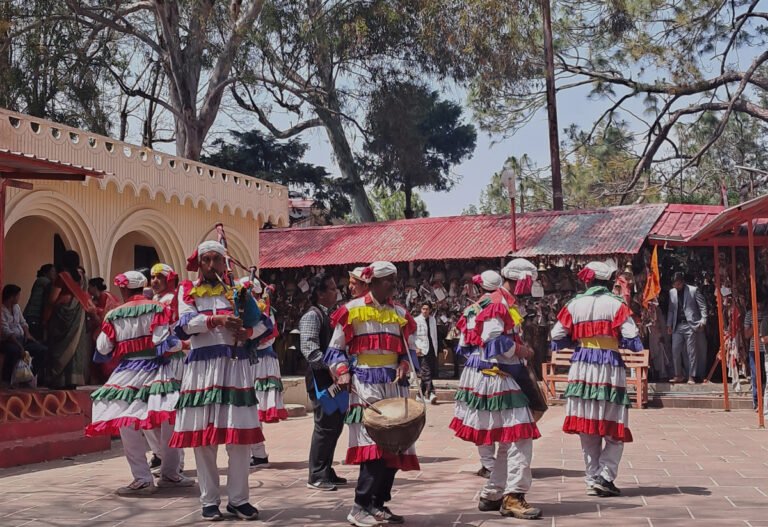
Dance featuring a staged fight
The duel is the center of a Chholiya performance. Two dancers face each other with a sword in the right hand and a shield in the left, and what they perform is not open combat but trickery. Chhal, the word for trickery, gives the dance its name [2]. A dancer is called a chholyar.
The fight is staged, but the movements are precise. The dancers move in pairs in a synchronized manner.
The dhol player directs it all. The dance has rhythms fixed for different stretches of the performance, and the chholyars’ footwork changes as the lead drummer’s taal changes [2]. The dance stops at intervals while the musicians sing chanchari and chhapeli (Kumaoni folk songs) and then the swords come up again [2].
The music
The musicians are the other half of the Chholiya group. The percussion is the dhol and the damau, native to Kumaon and played by drummers known as dholis [1]. The brass — turi, nagphani, ransing — are the region’s old battle instruments, once sounded to keep up the morale of troops on the field [1]. The instrument that carries farthest is the mashakbeen or bagpipe [4].
The mashakbeen is the newest member of the ensemble. The British recruited heavily from the Kumaon and Garhwal hills, and soldiers who joined their regiments were trained to play in army pipe bands; the Scottish bagpipe came home with them [4]. The researcher Andrew Alter found that the pipes played in Kumaon today are Scottish Highland bagpipes, with no evidence of the instrument in the region before British rule [5]. The bagpipe also suited the terrain. It stores air, so a musician can play it while climbing, and its sound crosses valleys — a wedding party announces itself long before it can be seen [4].
Why it leads a wedding procession
A wedding was believed to draw evil spirits toward the couple, and that belief gave Chholiya its place in the procession: its show of arms keeps the spirits off, so the dance leads the baraat instead of walking inside it [1][8].
The story told in Kumaon is that the dance began around a thousand years ago, in the martial life of the old hill kingdoms [2]. Narendra Prasad, a Chholiya performer from Pithoragarh, puts the older function simply: “Earlier, the Chholiya performers used to lead the army in the battlefield” [3].
The group
A working group usually runs ten to fifteen members, counting dancers and musicians together [2]. The dancers dress as Kumaon’s old soldiers — the long white chola, a turban, sandalwood paste marking the face — with the sword in the right hand and the shield in the left [8]. groups are professional: they are booked for a date, they travel to the wedding, and they are paid for the performance.
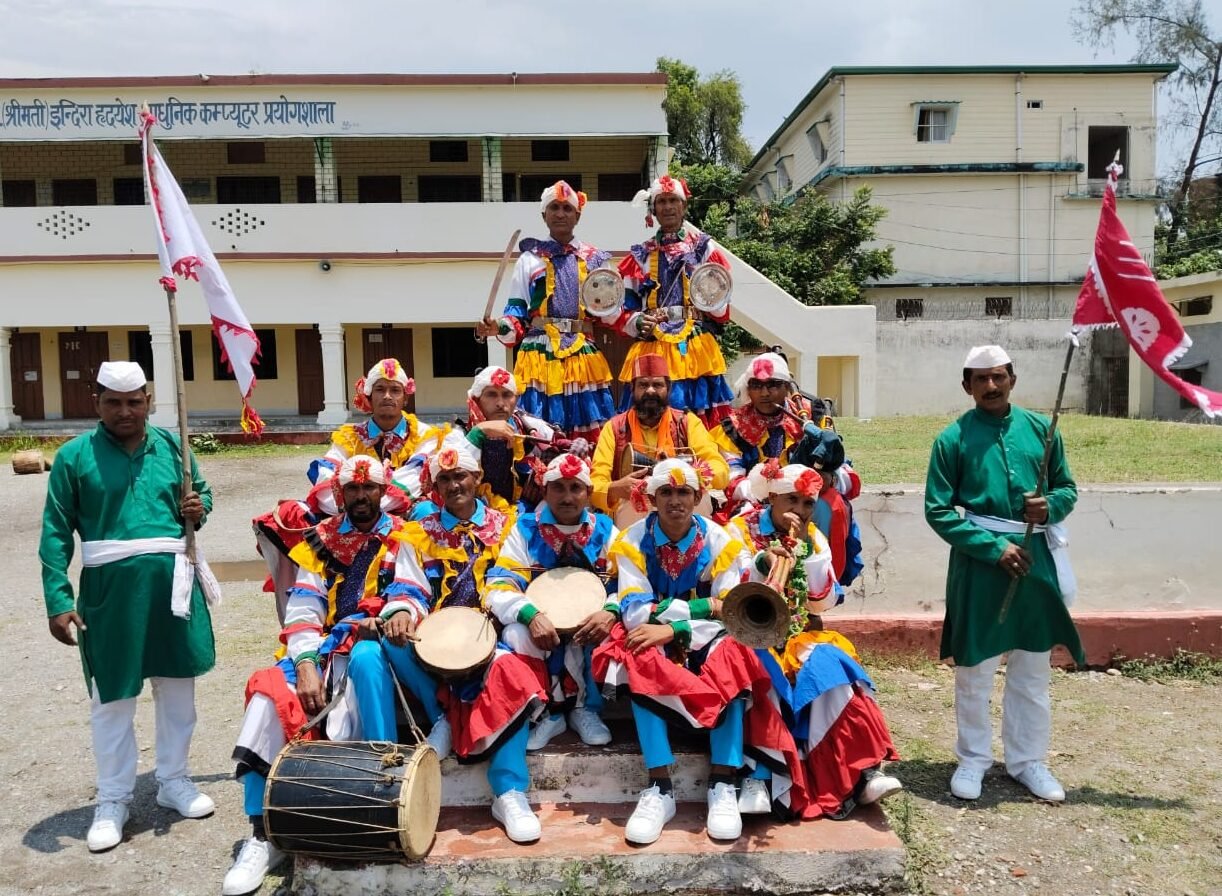
At weddings now
The dance now lives mostly in wedding processions, and increasingly in the newer towns. After a period when the performers’ livelihood was in question, their numbers at urban weddings have been growing — though in most processions the group performs alongside a band-baja rather than replacing it [2].
Demand still runs ahead of supply. Pahadi weddings cluster on auspicious dates, and a single good date can hold dozens of weddings across a region served by far fewer Chholiya groups. A group can charge anywhere between ₹25,000 and ₹50,000 for a wedding [7].
The state has also taken the dance up as a showcase. In October 2023, about 3,000 Chholiya and jhoda artists from Pithoragarh district performed together for the Prime Minister’s visit to the border region, an event entered in the World Book of Records [6]. Between the wedding season and the government stage, Chholiya remains a working trade, hired by the day and still walking ahead of grooms across Kumaon.
Sources
- [1] Chholiya — Wikipedia
- [2] कुमाऊँ का छोलिया नृत्य — Kafal Tree
- [3] Chholiya is more than just a Himalayan Folk Dance — SDC Foundation
- [4] A reminder for the Scots: India has a thriving bagpipe tradition too — Scroll.in
- [5] Mashak — Wikipedia
- [6] Chholia, Jhauda folk dancers of Uttarakhand get place in World Book of Records — ANI
- [7] Based on local knowledge provided to Hisalu.