

Buransh
Pahad Culture · Flora and Fauna
Buransh is the state tree of Uttarakhand. Its botanical name is Rhododendron arboreum, an evergreen Himalayan tree whose flowers bloom in a deep red color in early spring, when much of the hillside is still bare. In Kumaoni and Garhwali, the word buransh usually means the flower itself — the flower that is picked, offered at a doorstep, and pressed into juice — more than the tree it grows on. [1]
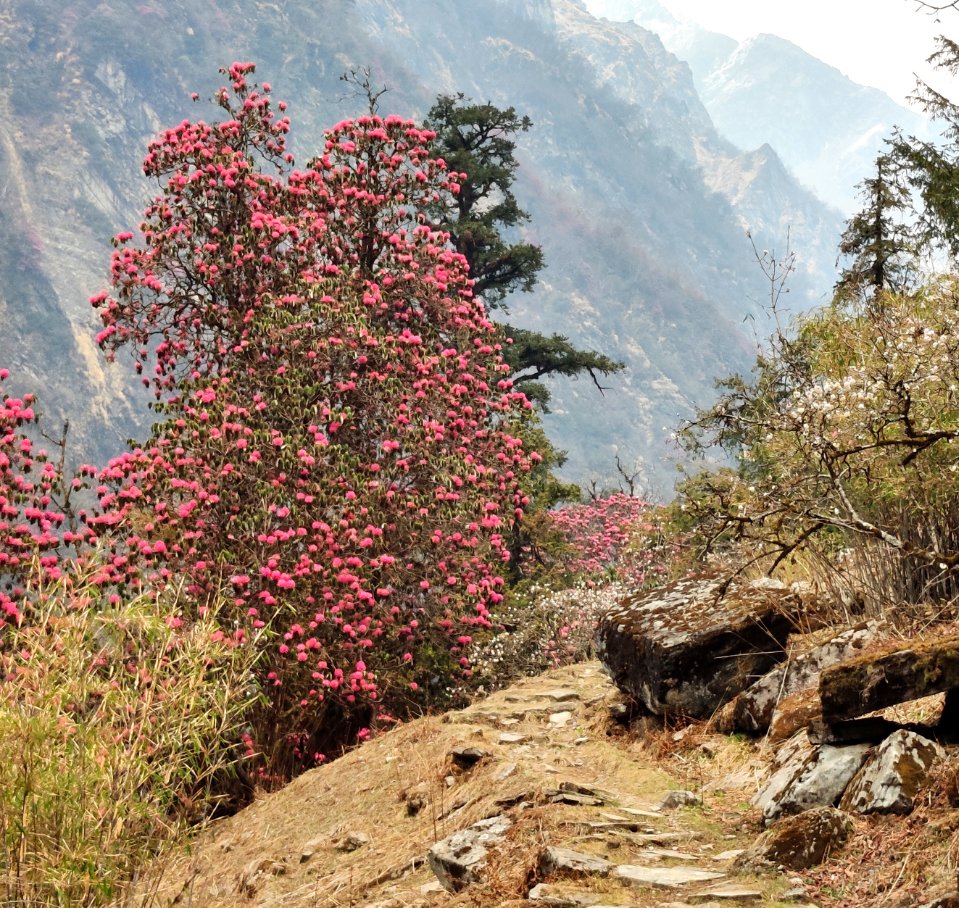
Buransh blooms at the start of spring, and it coincides with Phool Dei, the spring festival of Kumaon and Garhwal. During the festival, children carry flowers to each house and scatter petals across the dehli (doorstep), in exchange for sweets and coins. [2] The flower also has a place in worship: petals are offered to deities in household and temple ceremonies across the region. [1]
The flower people harvest
For a growing number of households, buransh brings an additional seasonal income. The flowers are edible — they taste a little sour-sweet — and are made into juice or a sweetened squash. These have become one of the hills’ most common cottage products. Along the roads that climb into the hills — like the Bhowali route between Haldwani and Almora — bottled buransh squash now sits on shelves at roadside stalls and small processing units, sold to residents and, increasingly, to tourists. A liter bottle runs roughly 100 to 150 rupees. [10]
The scale behind those bottles is documented. A study from the Chamoli district found that harvesters earned about 30 to 60 rupees per kilogram for fresh flowers. A household collecting between 25 and 350 kilograms in a season earned somewhere between 6,000 and 37,000 rupees from the work. [3] Individual processing units and village cottage industries turned out anywhere from 2,500 to 7,500 liters of squash in a single flowering season, depending on their size. [3] Flower collection of this kind has become a real line of rural income across the Garhwal hills, drawn from a forest tree that no one plants. [4] The petals feed other preparations too — jelly, pickles, and chutney. [1]
Buransh juice is also believed to be good for health. The flower extract shows strong antioxidant activity in lab tests, and the flowers hold flavonoids that researchers have linked to anti-inflammatory and cardioprotective effects in early studies. [5] In the older medicinal tradition recorded for the tree, the flowers and bark are used against digestive and respiratory complaints, and young leaves are pressed to the forehead to ease a headache. [1] These are traditional uses and preliminary findings rather than settled clinical fact, but they are part of why the drink is sold and bought as more than a novelty.
The species and its range
Rhododendron arboreum is an evergreen tree of the Ericaceae family that can reach twenty meters, with thick, leathery leaves, dark green on top and pale or rusty-brown underneath, and dense rounded clusters of bell-shaped flowers. [1] In Uttarakhand it grows roughly between 1,500 and 3,000 meters, and it favors cooler, shaded aspects rather than hot open faces. The flower’s color shifts with height. Through the middle elevations it is the blood scarlet the tree is known for. Higher up it pales toward pink and, at the top of its range, white. [1]
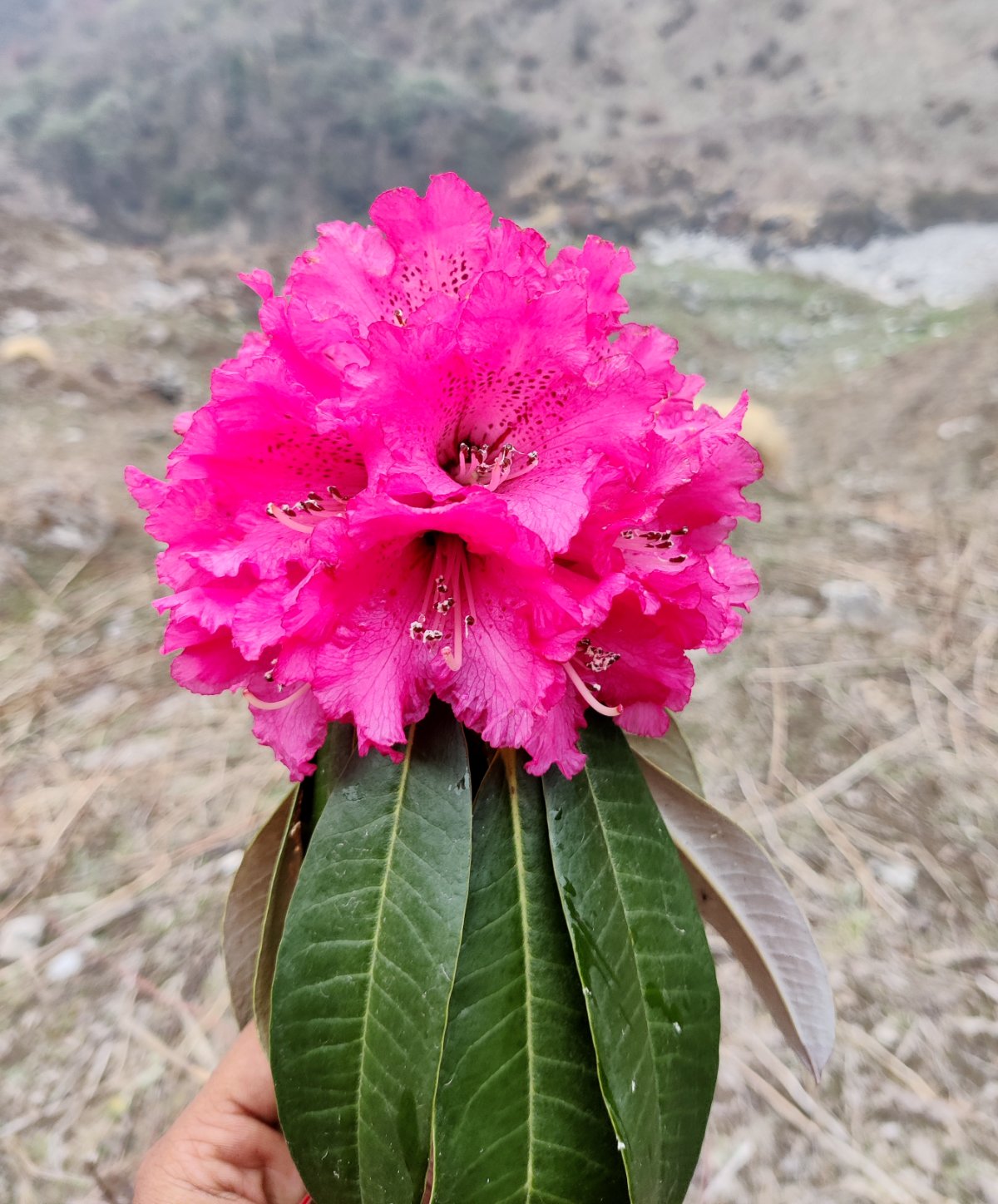
Climb past the tree line, though, and the pink belongs to a different species. On the upper Pindari trek, around 3,000 meters, the rose and mauve trusses growing among the last conifers are Rhododendron campanulatum — known in Garhwal as chimul or simru — a timberline shrub of the alpine zones that flowers pink to lilac and forms dense thickets between roughly 2,800 and 4,000 meters. [6] Beyond Uttarakhand, the red R. arboreum is the national flower of Nepal, where it is called lali gurans, and the state flower of Nagaland. [7]
The season of buransh
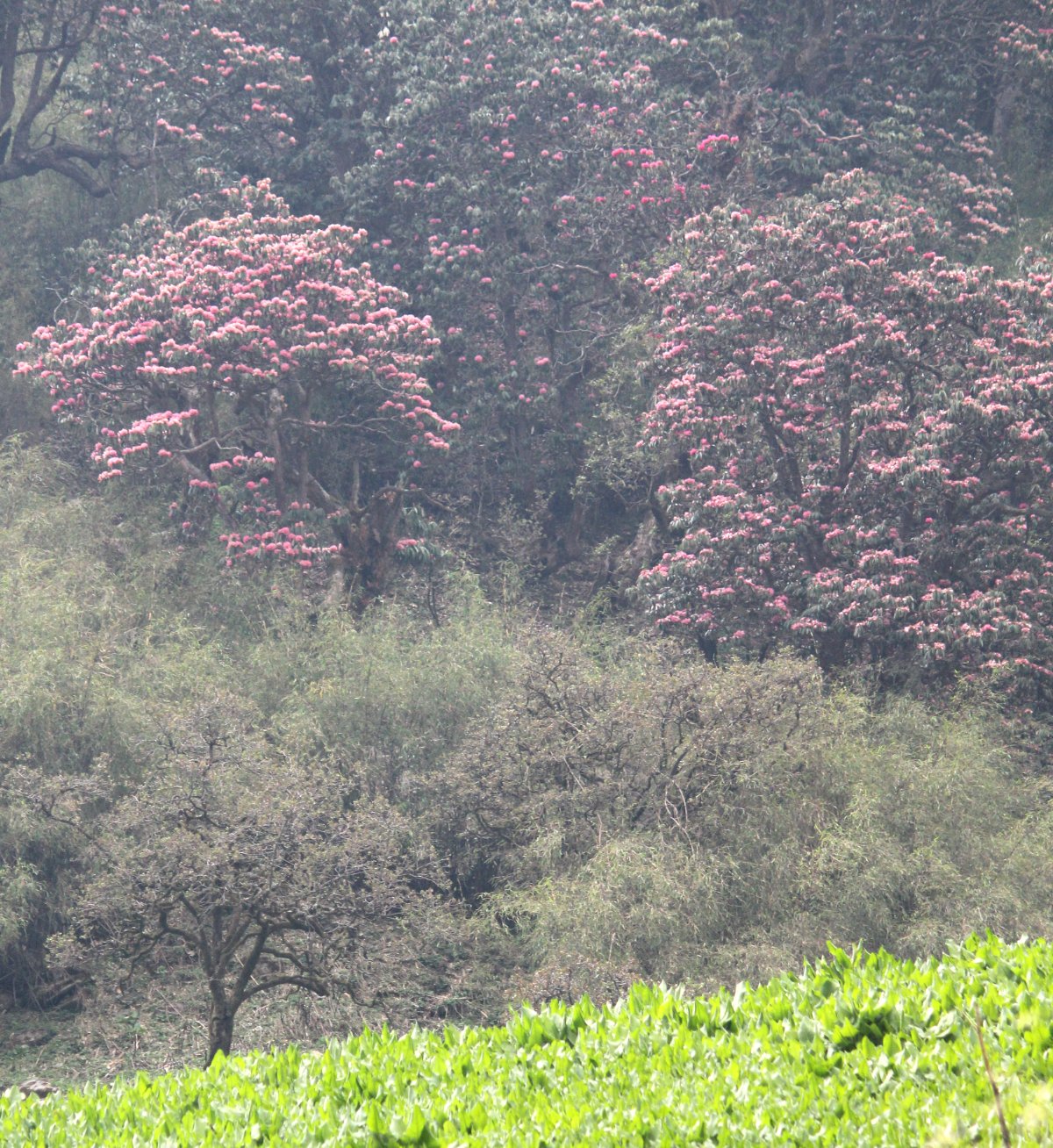
Buransh has long flowered in early spring, with its main bloom in March and April; the flowering season for the species can extend as late as November in higher stands. [1] In recent years that timing has moved earlier. Across mid-altitude Uttarakhand — around Nainital, Almora, and Tehri — the red flowers have been appearing in December and January, weeks to months ahead of their usual season. [8] A field study across altitudes in Bageshwar district in early 2024 recorded the same shift and linked it to warmer winters and lower winter rainfall. The tree needs a steady spell of about 15 to 20 degrees Celsius to bloom, and winters now reach that warmth sooner. [8] Reporting from across the Himalaya has connected the change to the wider warming of the range. [9]
When the flower blooms early, the insects that pollinate it may not be active yet. [8] Over time, warming is also expected to push the tree’s range higher up the slopes, thinning it at the lower edge of its band. [9]
Sources
- [1] Uttarakhand State Tree: Burans — Rhododendron arboreum Sm. — Botanical Survey of India, ENVIS.
- [2] Phool Dei: Uttarakhand’s festival of flowers to teach kids environmental conservation — Down To Earth.
- [3] Value chain analysis of Rhododendron arboreum squash ‘buransh’ as a non-timber forest product (NTFP) in Western Himalayas: Case study of Chamoli district, Uttarakhand — Trees, Forests and People (ScienceDirect).
- [4] Extraction of Rhododendron arboreum Smith flowers from the forest for the livelihood and rural income in Garhwal Himalaya, India — Scientific Reports.
- [5] Health Benefits, Utilization and Characterization of Rhododendron arboreum (Ericaceae) — ResearchGate.
- [6] Rhododendron campanulatum — Great Himalayan National Park (official website).
- [7] Rhododendron arboreum — Wikipedia.
- [8] Climate-Driven Early Flowering in Rhododendron arboreum: Field Observations Across Altitudes in Bageshwar, Uttarakhand — Research Square (preprint).
- [9] Rhododendron bloom early in the Himalayas — Dialogue Earth.
- [10] Based on local knowledge provided to Hisalu.