

Bal Mithai
Pahad Culture · Food
Bal mithai is the sweet Almora is known by. It’s a dark brown mithai of khoya roasted until it takes the color of chocolate, cut into small rectangles, and rolled in tiny white sugar balls. The sweet has been made in the town for about a century and a half [1][2], and in that time it has arguably traveled further than almost anything else Almora makes. It is the box a visitor is told to buy and the box a pahadi carries when leaving the hills.
The name comes from the coating: ‘bal’ for the small white sugar balls, and ‘mithai’ for sweet.
The sweet that stands for a town
Few Indian sweets are tied to one town the way bal mithai is tied to Almora.
The tie shows in public moments. In May 2022, after India won the Thomas Cup in badminton, Prime Minister Narendra Modi asked Lakshya Sen — a young badminton player from Almora — to bring him the town’s bal mithai, and Sen presented it at a meeting with the team the following week [3].
The tie is also old. Accounts in Almora say the sweet traveled to England with British officers going home for Christmas, and that soldiers from Kumaon carried it to the Burma front in the Second World War [2][4]. These stories live in the town’s telling rather than in official records, but they show how long Almora has understood the sweet as its own.
Where it began
The invention is credited to Joga Lal Sah, a halwai whose shop opened in Lala Bazaar in Almora in 1865 [1][2]. His shop, Lala Joga Sah, still runs in Lala Bazaar under his descendants [1]. A second shop of the same era, Heera Singh Jeewan Singh, also stands in Lala Bazaar, and both are now more than a hundred years old [5].
The most famous name today is Kheem Singh Mohan Singh, near the bus stand. The brothers who founded it, Kheem Singh and Mohan Singh Rautela, worked at Joga Lal Sah’s shop before opening their own [1][4]. The location did the rest — travelers passing through Almora bought their boxes near the bus stand and carried the shop’s name across the country [4].
How it is made
The base is khoya, milk reduced over heat until only its solids remain. The khoya is roasted in ghee on a low flame until it darkens and caramelizes, then mixed with sugar, spread to cool, and cut into rectangles. Each piece is rolled in the white sugar balls that give the sweet its name [1][4]. The coating was once poppy seeds rolled in sugar; plain sugar balls replaced them over time [1][4].
Both parts were once made close to home. Villagers around Almora made khoya over oak-wood fires and brought it to the town’s market to sell, and the white balls too were made locally before supply shifted to Ramnagar, in the plains below Kumaon [2]. The sweet keeps for days without refrigeration, which is part of why it became the sweet people carry [4].
A family of pahadi sweets
Bal mithai is the best known of a family of pahadi sweets sold in the same shops. The old Almora shops also make chocolate, singauri (khoya wrapped in oak leaves and eaten out of them) [1] — khechua, white peda, and brown peda [5].
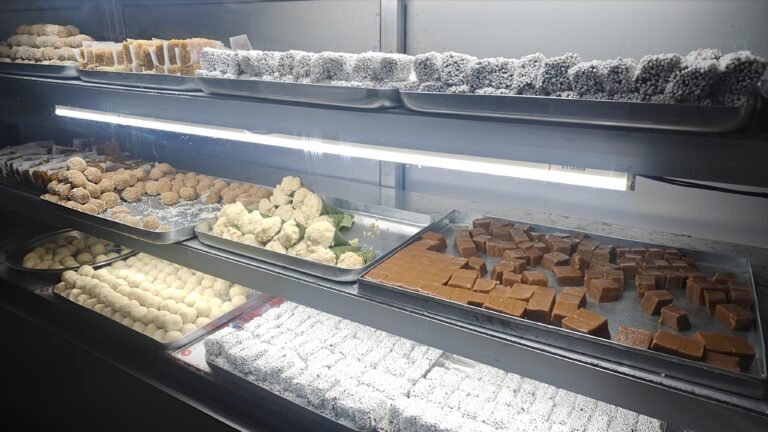
It is a gift sweet more than a daily one. It moves at weddings and festivals, in boxes exchanged between families, and in the luggage of anyone leaving the hills [6].
Almora’s bal mithai now
Demand has never been higher. Hundreds of newer shops selling bal mithai have opened across Almora — in the bus station market, in Dharanaula, in Lodhia, and scattered through the town [5]. Food and travel creators visit, film the shops, and put the sweet in front of audiences that had no earlier reason to look toward Almora. Much of the current demand traces to this digital visibility [5].
Scale has its downsides. As shops multiplied, khoya began arriving from suppliers where its quality is harder to trust [4]. The old shops have held their standard — the bal mithai at Lala Joga Sah, Heera Singh Jeewan Singh, and Kheem Singh Mohan Singh is still the quality the shops built their names on — while quality at many of the newer counters is lower [5]. There has been a push to secure Geographical Indication protection for bal mithai and singauri under the Geographical Indications of Goods Act, 1999, which would legally tie the sweets’ names to their place of origin [1].
A hundred and sixty years after Joga Lal Sah’s shop opened, the sweet is easier to find than it has ever been, in Almora and far outside it. Whether what is found matches what the town has been making since 1865 depends on which counter it comes from.
Sources
- [1] Bal mithai — Wikipedia. Accessed July 2026.
- [2] कहाँ से आई अल्मोड़े की बाल मिठाई — Kafal Tree. June 2022.
- [3] Shuttler Lakshya Sen fulfils his promise, gifts Almora’s ‘Bal Mithai’ to PM Modi — ANI. May 22, 2022.
- [4] The Origins of Almora’s Legendary Baal Mithai — Ashish Verma, GOYA. 2024.
- [5] Based on local knowledge provided to Hisalu.
- [6] Bal Mithai: Uttarakhand’s Iconic Sweet from the Hills of Almora — Mindbrews. 2025.