

Aipan
Pahad Culture · Arts and Crafts
Aipan is the ritual art of Kumaon used to decorate homes during special occasions, festivals, and ceremonies. The art is practiced on floors, walls, and dehli (doorsteps), using geometric and figurative designs. The medium of the art is simple: white rice paste on a base of red geru (ochre). Each Aipan design is called a chowki (a seat prepared for a deity) and belongs to a specific occasion: one for a wedding dehli, another for a prayer room during Diwali, another for the day a child begins to read and write. The designs are usually drawn by a woman of the household, working from patterns she learned by watching her mother and other elder women.
The word “Aipan” comes from the Sanskrit lepana, which means to plaster or coat a surface. [2] In Kumaon, the practice is believed to have taken shape during the Chand dynasty, which ruled the region from roughly the 10th to the 18th century, with Almora as its seat. [3] The tradition spread across the Kumaon hills and stayed rooted there. Aipan is specific to Kumaon — it is not traditionally practiced in the neighboring Garhwal region.
Traditional materials and technique
The base material is geru, a red clay found across the Kumaon hills, soaked in water to make a thick, smooth paste. The surface — historically a mud floor or wall — is coated with geru first. The designs are drawn with a white paste made of rice flour.
The traditional drawing tool is the hand. Women use the tips of three fingers — the forefinger, ring finger, and middle finger — dipped in the rice paste, moving across the surface freehand. [1] Every design begins from a central point, the bindu, and radiates outward. [9]
The designs draw inspiration from the natural world and from religious symbols: lotus flowers, betel leaves, conch shells (shankh), fish, the swastik, the trishul, and more. The underlying structure is formed by geometric patterns: dots, lines, squares, circles, and triangles. [4]
Which design belongs where
What makes Aipan distinct from a general decorative art is that the patterns are not chosen freely. Each design belongs to a specific ritual, festival, or life event.
The most recognizable designs include:
Lakshmi Yantra, drawn during Diwali, Dhanteras, and Ashtami. It includes the padchinha — footprints of the goddess Lakshmi — drawn from the main entrance of the house all the way to the prayer room, showing her path into the home. The footprints are a symbol of wealth and well-being arriving at the household. [5]
Dhuli Arghya, the wedding chowki. This is a long, vertical design drawn in the bride’s courtyard to welcome the groom. The groom stands on this chowki when he arrives at twilight. The central figure resembles a pitcher with a trishul (trident) rising from its top. [4]
Saraswati Chowki, drawn for the worship of Saraswati, the goddess of knowledge. It is made on Basant Panchami, and when a child begins their formal education. The design features a central square decorated with lotus motifs and lamps, creating a seat for the goddess to preside over the beginning of study. [4]
Nav Durga Chowki, used for Navratri pujas and ritual Devi worship. It is built around nine dots — one for each of the Nav Durgas — enclosed in a square with crisscrossing parallel lines and decorated with lotus petals. [4]
Other designs serve other occasions: Shivarchan Peeth for the worship of Shiva, Acharya Chowki for the pandit or guru who presides over a ceremony, Janeyu Chowki for the sacred thread ceremony, Surya Darshan Chowki for the sun. [4]
Beyond the chowkis, there is the Vasudhara — the vertical lines drawn around doorsteps, prayer altars, and the tulsi plant. Vasudhara lines are drawn in odd numbers: five, seven, nine, or eleven. Without these lines, an Aipan is considered incomplete. The lines represent a continuous flow of prosperity into the home. [5]
Who practices, and how the knowledge moves
Aipan is practiced by the women of a household. The knowledge moves through the female line, e.g., mother to daughter, mother-in-law to daughter-in-law. Historically, there were no teaching sessions, no books, no formal training. A girl watched her mother prepare the geru and the rice paste, watched her draw the patterns on the floor before a festival or a puja, and over the years, she learned. The patterns lived in the hands of the women who drew them, and the rules lived in the households that observed them.
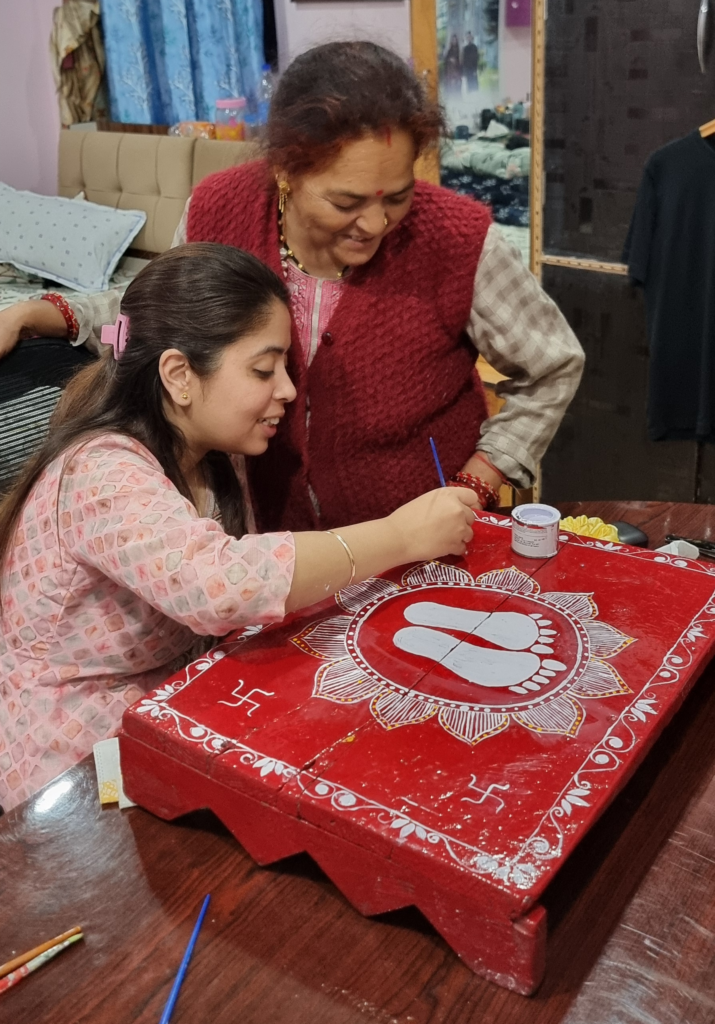
This method of learning depends on regular practice. When women draw Aipan before every festival, every ceremony, every auspicious day, the patterns stay alive in muscle memory and household knowledge. As families have moved to cities and the floor has changed from mud to polished tile, the occasions for drawing have become less frequent, and the everyday passing down of specific design knowledge has slowed with them.
But the art has not disappeared — it has started finding new routes. Organized projects like Minakriti employ rural women to produce hand-drawn Aipan and, in the process, keep the craft and its rules in active use. The younger generation in Kumaon has made Aipan more visible to the outside world than it has ever been. The art form appears on social media, on merchandise, in design exhibitions, and more. [6] The specific ritual knowledge — which chowki belongs to which occasion, why the Vasudhara must be odd, what the symbols in a Nav Durga design represent — is not yet as widespread as the aesthetic. But the interest is real, and it is creating demand for deeper knowledge, not just the surface patterns.
How the medium has evolved
Aipan was always made to be temporary. The designs were drawn on mud floors, walls, and doorsteps that would be washed and redrawn for the next occasion. The temporary nature was part of the meaning — each drawing was a fresh offering, made for the moment.
The medium has changed at every stage, and the practice has adapted each time.
The first shift was from mud floors to cement. As houses modernized, the surface changed, but geru and rice paste work on cement too, and many households continued drawing by hand.
The second was from geru and rice paste to commercially available red and white paint — the kind that comes in a tin. This made the process faster and the designs more durable. It also changed the texture of the work — grinding the rice and filtering the geru had been part of the preparation, and paint removed that step. [6]
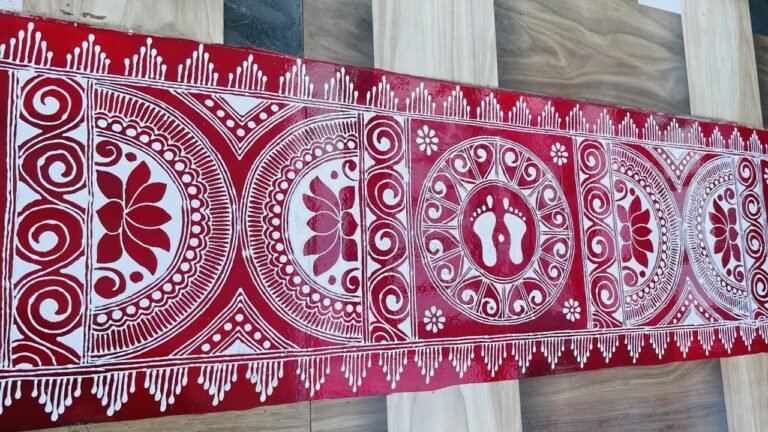
The third is the most recent: ready-to-stick Aipan stickers. Pre-printed vinyl designs in the traditional red-and-white patterns, sold widely online and in local markets. During Diwali especially, stickers have become the most common way Aipan appears on doorsteps — easier, faster, available to anyone regardless of whether they know how to draw. [6] [7]
At each stage, something changed in what the practice involves. And at each stage, Aipan continued to show up — on new surfaces, through new materials, in new hands.
Economics and the new forms
Aipan was household practice — unpaid, uncounted, part of the rhythm of domestic and ritual life. In the last decade, it has also become an economic activity, and the change runs in two directions.
In September 2021, Aipan received a Geographical Indication (GI) certificate, recognizing it as a traditional art form of the Kumaon region. [8] The GI tag was supported by NABARD and is intended to protect the authenticity of Aipan products and provide economic recognition to the artisans who produce them. [9] A 2025 study from Kumaon University, Nainital, looked at how the GI tag affected the livelihoods of Aipan artisans in the district. The tag brought recognition, but the artisans are still struggling with market access, raw material availability, fair pricing, and the need for further training. [10]
Several organized efforts have worked to turn Aipan into a source of income for women in rural Kumaon. Minakriti: The Aipan Project, started by Minakshi Khati in December 2019, employs women from rural households to produce hand-drawn Aipan pieces and fulfill orders. As of reporting, the project had processed over a thousand orders. [11] A separate initiative, Project Aipan, was started by the Enactus team at Indraprastha College for Women in Delhi. Its approach was to teach the artisans business skills so they could run the operation themselves, not just produce for someone else. [1]
The state government has also adopted Aipan as a visual identity for Uttarakhand. In 2015, under Chief Minister Harish Rawat, the government decided that Aipan art would be displayed in government offices and buildings across the state, including those of GMVN, KMVN, and UPCL. [13] The government launched Cheli Aipan to promote the art form. [12] More recently, uniform signage boards featuring Aipan designs have been installed on shops in market areas — part of a broader effort to give marketplaces in the state a distinct visual identity. [14] [6]
At the same time, the art form has migrated to new surfaces entirely. Younger artists in Kumaon are painting Aipan patterns on coasters, posters, wall hangings, fabric, and merchandise — objects that can be sold, shipped, and displayed year-round. [6] The migration to new surfaces has made Aipan visible to people who would never have seen it on a village doorstep, and it provides income to artists who would otherwise have no market for the skill.
Aipan now
Aipan is more visible today than it has been in a generation. It has a GI tag, organized revival projects, a commercial market, and an online following driven largely by younger people from Kumaon who are proud of the tradition and want it seen. [6] The red-and-white patterns have become, for many, a visual shorthand for Kumaoni identity.
Sources
- [1] Aipan art — Wikipedia.
- [2] Virmani, Meeta, and Nitansha Bansal. “Seeking Sustainable Heights in the Lives of Women Through Aipan.” Journal of Innovation for Inclusive Development, Vol. 3, No. 1, February 2018, pp. 40–44.
- [3] Aipan: Ritualistic Folk Art of Kumaon — Google Arts & Culture.
- [4] D’source Art Forms — Aipan, Uttarakhand. Prof. Bibhudutta Baral et al., NID Bengaluru.
- [5] Aipan — Aipan Designs, Indian Aipan Design — Cultural India.
- [6] Based on local knowledge provided to Hisalu.
- [7] Aipan Stickers — Pahadi Foods Online.
- [8] “GI tag for 7 indigenous products of Ukhand.” The Times of India, September 2021.
- [9] Uttarakhand Aipan — NABARD GI Products.
- [10] Oli, Divya, Jitendra Kumar Lohani, and Rajnish Pande. “Economic Empowerment Through GI Tagged Folk Art: Assessing the Livelihood Impact of Aipan Artisans in the Nainital District of the Uttarakhand Himalayas.” Indiana Journal of Economics and Business Management, Vol. 5, No. 3, 2025, pp. 24–30.
- [11] “Uttarakhand girl revives traditional Himalayan artform Aipan, creates jobs.” Hindustan Times, November 2020.
- [12] Krishna, Geetanjali. “Cheli Aipan: A unique initiative to make traditional folk art lucrative.” Business Standard, November 2018.
- [13] Kunwar, Darshan. “Aipan paintings to brighten govt offices.” The Times of India, December 2015.
- [14] “Installation of Aipan signage boards affecting shopkeepers’ business.” Pioneer Edge, December 2023.